From Lab to Life: Why Lightweight AI Matters in Real-World Medical Screening
Many medical AI models look impressive in research papers, but far fewer are built for the places where people actually need them. Lightweight AI matters because useful healthcare technology should not stop at the lab.
The real problem no one talks about
In health care, early detection matters. For example, a small change in retinal structure can be the first sign of eye disease progression. Sometimes, a tiny region in an image carries important clinical meaning. But identifying that region accurately requires precise image segmentation.
This is where many AI systems face a real-world problem. The models may be powerful, but they are also heavy, resource-hungry, and difficult to deploy outside specialized environments. So while the algorithms improve, access does not.
“What is the minimum model needed to solve this problem reliably?”
That shift in thinking changes everything. Because in healthcare, a model is only truly useful if it can actually be used.
Lightweight Deep-Learning Architecture
One of the reasons lightweight AI is so important is that it does not simply aim to shrink a model. It aims to keep the most meaningful information while removing unnecessary computational burden.
In practice, this means learning feature representations that preserve anatomical structure and disease-relevant patterns without depending on oversized networks. A compact architecture can still perform segmentation and prediction in a unified way while remaining far more practical for deployment.
This is the kind of design philosophy that matters for screening systems intended for low-resource hardware, CPU-only inference, and portable medical applications.
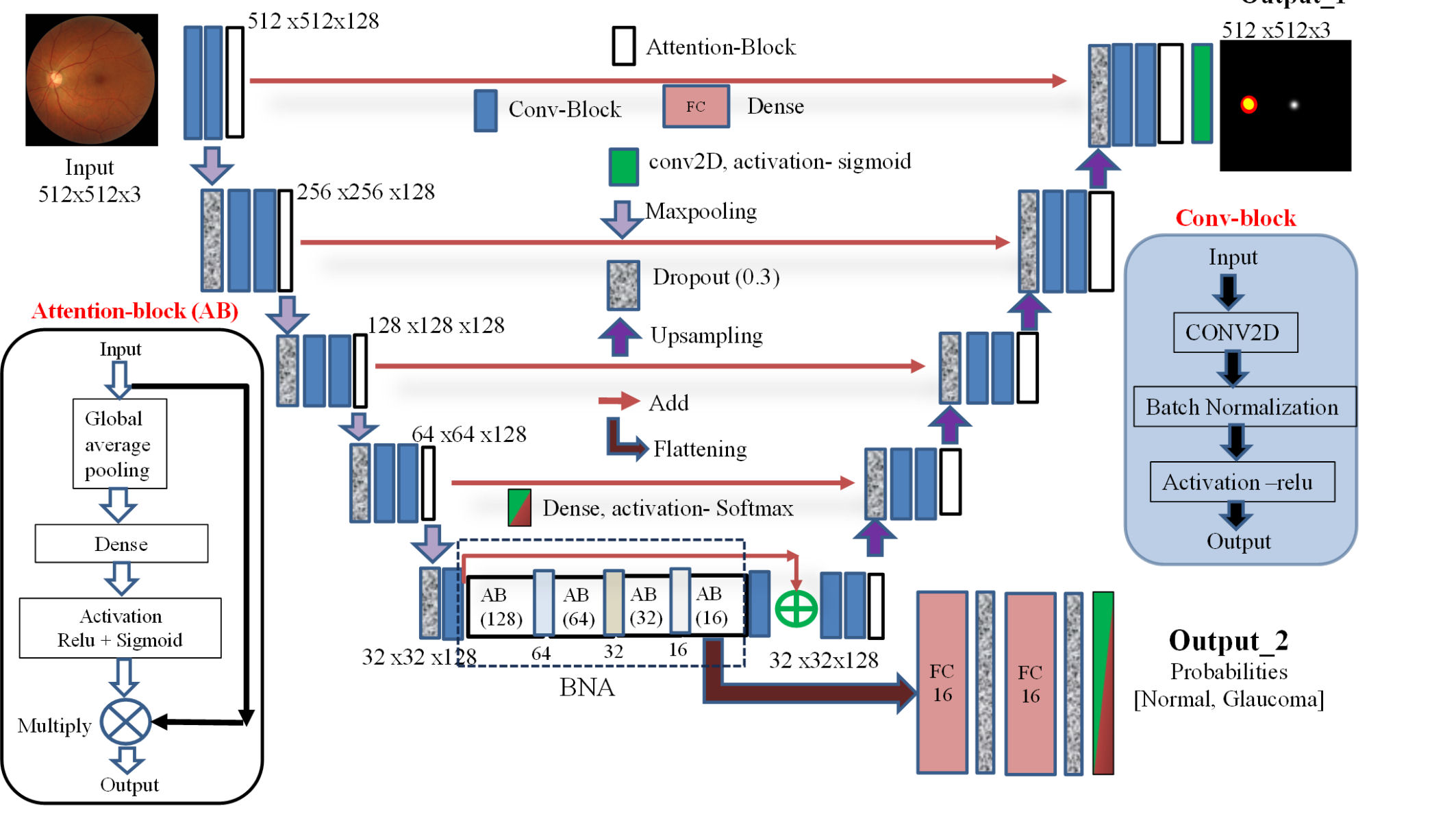
Figure 1. Multi-task learning (MTL) architecture that jointly performs segmentation and classification to extract meaningful image features and support robust disease prediction.
Why this matters more than a benchmark score
The real value of lightweight AI is not only that it can perform well. It is that it can perform well while remaining realistic enough for practical use.
What lightweight design tries to achieve
- Keep the most relevant image features
- Reduce redundant information
- Narrow channels intelligently
- Preserve structure while lowering memory and computation
Why that matters
A model is not impactful just because it is accurate in isolation. It becomes impactful when it can be used on real devices, in real environments, by real people.
A useful model is not only one that scores well. It is one that can survive the practical realities of deployment.
From Research to Real-World Impact
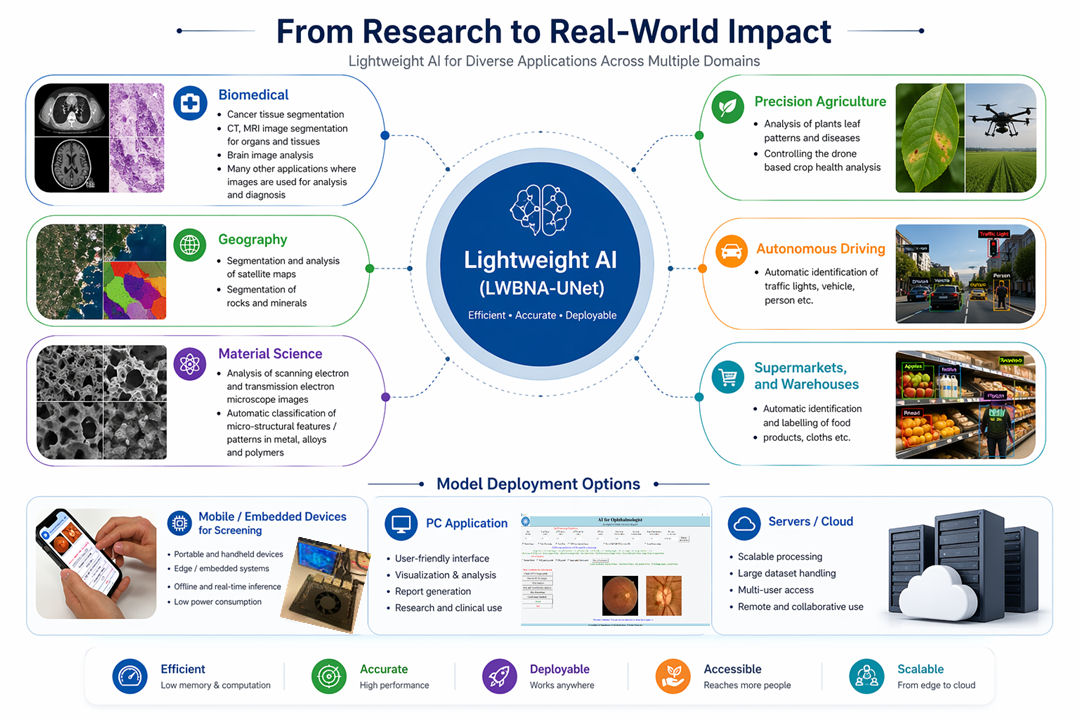
Figure 2. From research to real-world impact: lightweight AI enables applications across biomedical imaging, geography, materials science, precision agriculture, autonomous systems, and retail environments, with deployment ranging from embedded devices and PC applications to cloud infrastructure.
Lightweight AI is not just about improving model performance. It is about enabling AI systems to move beyond controlled research environments and into practical real-world use.
As this figure illustrates, the same lightweight design principles can support a wide range of applications across both medical and non-medical domains. These include biomedical image analysis, agricultural monitoring, materials science, autonomous systems, and other vision-based tasks where efficient computation matters.
Just as importantly, deployment does not need to be limited to large computing infrastructure. Compact AI models can be adapted to mobile and embedded devices, desktop applications, and cloud-based systems depending on the use case.
This broader adaptability is what makes lightweight AI especially important. It is not simply a technical optimization. It is a practical pathway for bringing advanced image analysis closer to where it can actually make a difference.
Why this matters beyond a single application
This philosophy is at the core of Lightweight-AI — building efficient, deployable deep-learning systems that can operate under real-world constraints on memory, computation, and power.
This is not just about individual models. It represents a broader direction for practical AI: segmentation, denoising, vessel analysis, and disease-oriented prediction designed with deployment in mind.
The real question is: “Can AI reach the people who need it?”
Lightweight AI is one answer to that question.